Knowledge & Education
Tracks
Each track is one line of development climbing the eight levels. A cell holds the step written at that level; cross-listed steps have their home in another sector and are shown here because this subject depends on them. Dashed cells are planned and not yet written; blank ones have nothing planned.
Records and writing
The mark, writing, paper and printing, and later the press.
Teaching
Schools and arithmetic for everyone, then knowledge held by an institution.
Science and measurement
Instruments, standard units, controlled comparison and publication, then the laboratory and statistics.
Everything in Knowledge & Education
Gathered from the steps above: the guides and builds that serve them, the reference sheets those carry, and every book the steps, guides and builds cite.
Field guides
Four-figure logarithms and trigonometry, square roots by Newton's method, and the two instruments that did the world's arithmetic before electronics.
Level 3The results every other science and machine is built on, in the order each needs the last: the formula, what it states, what it lets you do, and who first found it.
Level 0Every public institution an advanced civilisation runs, in the order a rebuilding one can found them: what each is for, when it becomes possible, and the rules that keep it honest, useful and no bigger than its job.
Level 3Fourteen branches, each with the handful of results a civilization cannot rebuild without, and where to learn the rest.
Level 3Force, energy, heat, light, electricity, relativity and the atom: the laws every engine, wire and lens obeys, each with what it lets you do and who first found it.
Level 3The sky as calendar, clock and compass, then orbits, distances and the universe: each result with what it lets you do and who first found it.
Level 2North is written in the sky twice a day and all night. Latitude is one angle measured at noon. Everything else is counting paces and not lying to yourself about the count.
Level 3What matter is made of and how it changes: amounts, gases, acids, the energy and speed of reactions, electrochemistry, and the reactions every industry on the ladder runs on.
Builds

A glass bead the size of a pinhead magnifies 150–350 times: enough to see yeast, blood cells and the larger bacteria that cause disease.
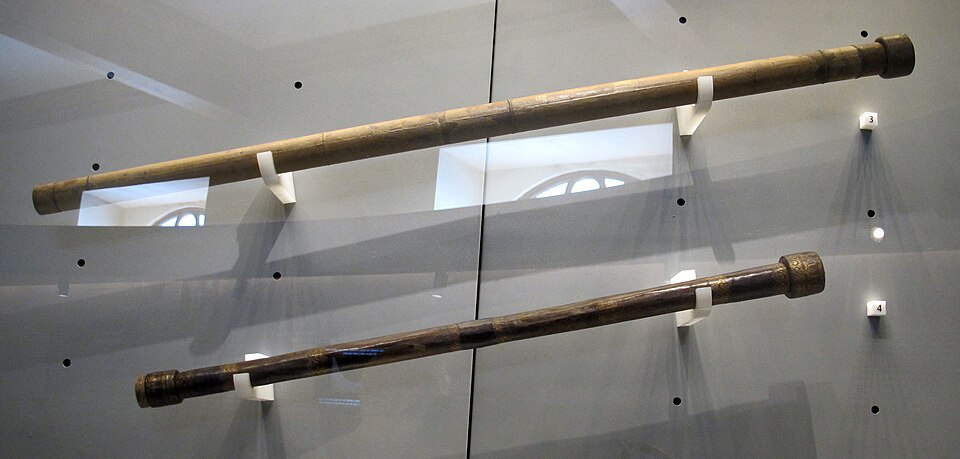
Two lenses in a tube: a 1-metre objective and a 25 mm eyepiece give 40×, enough to see Jupiter's moons and the phases of Venus.
Books and archives
- Wikipedia, offline (Kiwix ZIM) Archive · ~110 GB full with images · ~55 GB no-image · ~5 GB 'best of'
- On the Economy of Machinery and Manufactures Charles Babbage · Gutenberg #4238
- The Manufacture of Paper Robert Walter Sindall · Gutenberg #46449
- Mechanical Drawing Self-Taught Joshua Rose · Gutenberg #23319
- Encyclopædia Britannica, 11th edition (1911) Archive · ~1–8 GB depending on format
- Internet Archive Archive · Unbounded — curate
- The Art of Paper-Making Alexander Watt · Gutenberg #55757
- De Re Metallica Georgius Agricola (tr. Herbert Hoover) · Gutenberg #38015
- Modern Machine-Shop Practice (Vols I & II) Joshua Rose · Gutenberg #39225
- Areopagitica John Milton · Gutenberg #608
- OpenStax textbooks Archive · ~2 GB
- Physiology and Hygiene for Secondary Schools Francis M. Walters · Gutenberg #18779
- Encyclopædia Britannica 11th ed. — 'Logarithm' to 'Lord Advocate' Various · Gutenberg #42342
- Project Gutenberg (complete) Archive · ~90 GB with all formats · ~15 GB text only
- Elements of Arithmetic Augustus De Morgan · Gutenberg #68662
- The Slide Rule Charles N. Pickworth · Gutenberg #75904
- A Short Account of the History of Mathematics W. W. Rouse Ball · Gutenberg #31246
- The First Six Books of the Elements of Euclid Euclid and John Casey · Gutenberg #21076
- Calculus Made Easy Silvanus P. Thompson · Gutenberg #33283
- An Investigation of the Laws of Thought George Boole · Gutenberg #15114
- Robert's Rules of Order Henry M. Robert · Gutenberg #9097
- An Inquiry into the Nature and Causes of the Wealth of Nations Adam Smith · Gutenberg #3300
- Ancient Law Henry Sumner Maine · Gutenberg #22910
- The Federalist Papers Alexander Hamilton, James Madison and John Jay · Gutenberg #1404
- Considerations on Representative Government John Stuart Mill · Gutenberg #5669
- Lombard Street: A Description of the Money Market Walter Bagehot · Gutenberg #4359
- LibreTexts Archive · ~15 GB
- Creative Chemistry Edwin E. Slosson · Gutenberg #17149
- The Story of the Soil Cyril G. Hopkins · Gutenberg #4527
- The Telescope Louis Bell · Gutenberg #53740
- Measuring Tools Machinery (Reference Series No. 21) · Gutenberg #43375
- The Modern Clock Ward L. Goodrich · Gutenberg #61494
- Surveying and Levelling Instruments William Ford Stanley · Gutenberg #63834
- On Laboratory Arts Richard Threlfall · Gutenberg #22784
- On the Construction of a Silvered Glass Telescope Henry Draper · Gutenberg #53542
- The Microscope: Its History, Construction, and Application Jabez Hogg · Gutenberg #61233
- Treatise on Light Christiaan Huygens · Gutenberg #14725
- Standard Measures of United States, Great Britain and France Arthur S. C. Wurtele · Gutenberg #54208
- Men and Measures Edward Nicholson · Gutenberg #56290
- Newton's Principia: The mathematical principles of natural philosophy Isaac Newton · Gutenberg #76404
- The Principles of Science William Stanley Jevons · Gutenberg #74864
- A System of Logic, Ratiocinative and Inductive John Stuart Mill · Gutenberg #27942
- Elements of Chemistry, In a New Systematic Order, Containing all the Modern Discoveries Antoine Laurent Lavoisier · Gutenberg #30775
- Experimental Researches in Electricity, Volume 1 Michael Faraday · Gutenberg #14986
- Reflections on the motive power of heat Sadi Carnot · Gutenberg #78610
- The Chemical History of a Candle Michael Faraday · Gutenberg #14474
- The Fundamentals of Bacteriology Charles B. Morrey · Gutenberg #43227