Food & Agriculture
Tracks
Each track is one line of development climbing the eight levels. A cell holds the step written at that level; cross-listed steps have their home in another sector and are shown here because this subject depends on them. Dashed cells are planned and not yet written; blank ones have nothing planned.
Wild food
What the land gives before anything is planted: fish, nuts and game, and the identification that keeps foraging from killing you.
Crops and soil
Seed stock, the calendar, cleared ground and staples, then water control and fertiliser.
Protected growing
Glass, film and stored heat that move the growing season: the cold frame and manure hotbed, the glasshouse on a sunny wall, then the plastic tunnel, the heated glasshouse and the passive solar greenhouse. A cover gains heat by day and loses it by night, so venting, heating and pest control decide the harvest as much as the structure does.
Livestock
Animals for traction, fibre, milk and meat, and the diseases that cross from them to people.
Aquaculture
Fish grown in drainable earthen ponds, fed by plankton that the farm's own manure grows: a crop of tilapia or carp in about six months. Farmed fish are now more than half of the world's aquatic animal food.
Storage and preservation
Drying, salting, smoking, fermenting, cellars and granaries, then refrigeration and the cold chain.
Everything in Food & Agriculture
Gathered from the steps above: the guides and builds that serve them, the reference sheets those carry, and every book the steps, guides and builds cite.
Field guides
The highest calorie-return food source available to a group with nothing — and the one most often worked in the least productive way.
Level 0Wild plants and fungi are mostly water, fibre and vitamins. A handful of them are food worth carrying home, a handful will kill you in a way no taste, smell or cooking can warn you about, and the difference is knowledge you hold before you pick.
Level 0A trapline works all night while you sleep. A hunt works only while you are awake, usually returns nothing, and burns the calories it was supposed to find.
Level 1A glut eaten in the week it arrives is a feast. The same glut dried, salted, fermented or cellared is the difference between March and a famine.
Level 1The poisonings a rebuilding community is most likely to meet: where each comes from, how it shows, and the first thing to do.
Level 1A seed is a living embryo with a shelf life. Kept dry and cold it waits for years; kept warm and damp it dies in a season — and the difference is two rules of thumb and a sealed jar.
Level 1What a soil is made of, why its acidity matters, and how to read a nutrient shortage in the leaves before it costs a harvest.
Level 1Keep the soil covered, feed it, water the roots and fight pests without poisoning yourself: the modern practice that needs knowledge rather than machinery.
Level 1Animals turn grass nobody can eat into milk, meat, wool, leather, manure and traction. They also turn raw milk, a birthing ewe and a dog fed on offal into diseases that kill people.
Level 3Fourteen branches, each with the handful of results a civilization cannot rebuild without, and where to learn the rest.
Level 3Life from the cell up: the human body, microbes and immunity, inheritance and epidemics. Each result with what it lets you do and who first found it.
Level 2North is written in the sky twice a day and all night. Latitude is one angle measured at noon. Everything else is counting paces and not lying to yourself about the count.
Level 3The sky as calendar, clock and compass, then orbits, distances and the universe: each result with what it lets you do and who first found it.
Level 3The two dozen that decide who lives where there is no doctor: what each does, how it spreads, what kills it and which step stops it.
Level 0Surface water is a treatment problem every single day. Groundwater, reached and sealed properly, is a treatment problem once.
Level 3Water in and on the ground, the air and weather, rocks and time, earthquakes and tsunamis, and the climate: each result with what it lets you do and who first found it.
Level 3Turning the sciences into things that work: machines, structures, water in pipes and channels, heat through walls, and feedback control. Each result with what it lets you do and who first found it.
Level 3What matter is made of and how it changes: amounts, gases, acids, the energy and speed of reactions, electrochemistry, and the reactions every industry on the ladder runs on.
Level 3What a greenhouse is for, which kind to build, its parts and how to size them, and how to run its climate: from a cold frame over manure to a heated glasshouse and a solar greenhouse that needs no fuel.
Level 1Cloth is a chain of slow jobs — growing, retting, spinning, weaving, finishing — and for all of history the slowest link was spinning. A weaver needed several spinners working full time to keep one loom supplied.
Level 2A drainable earthen pond, manured from the farm's animals, grows fish without bought feed: site, species, water, stocking, feeding, daily care and harvest.
Level 3The basic set from the WHO list: what each treats, what it is made from, and the earliest tier that can make it. No doses, on purpose.
Level 3Force, energy, heat, light, electricity, relativity and the atom: the laws every engine, wire and lens obeys, each with what it lets you do and who first found it.
Builds
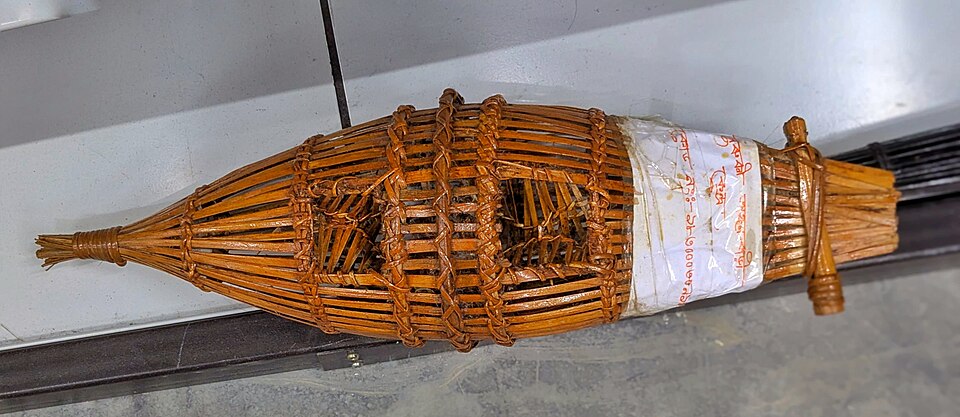
A woven basket that fishes all night while you sleep — the highest return-per-hour food gear in tier 0.
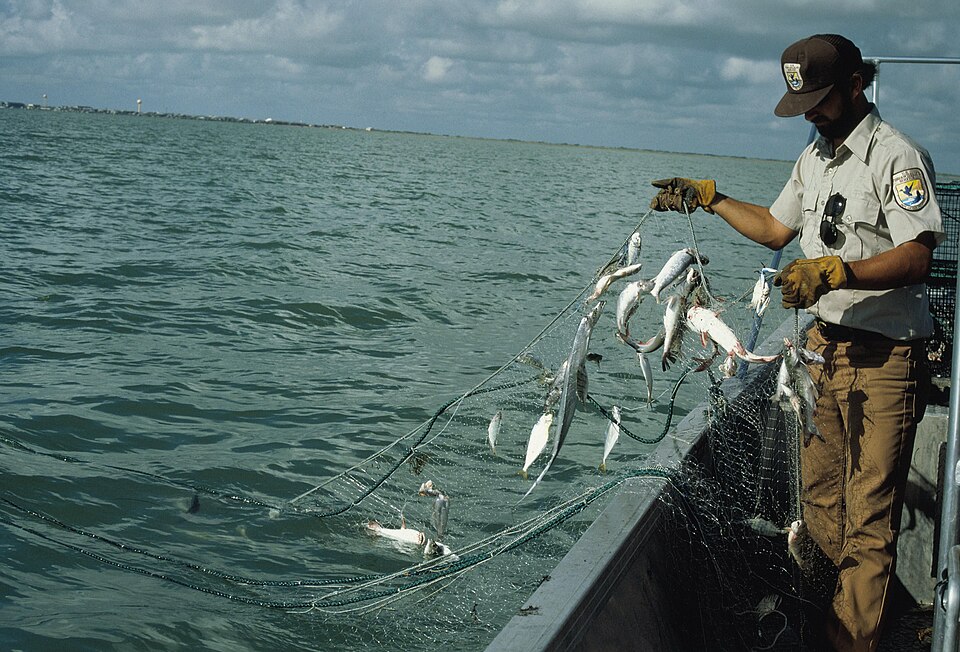
A wall of near-invisible mesh that fishes a whole channel while you do something else.
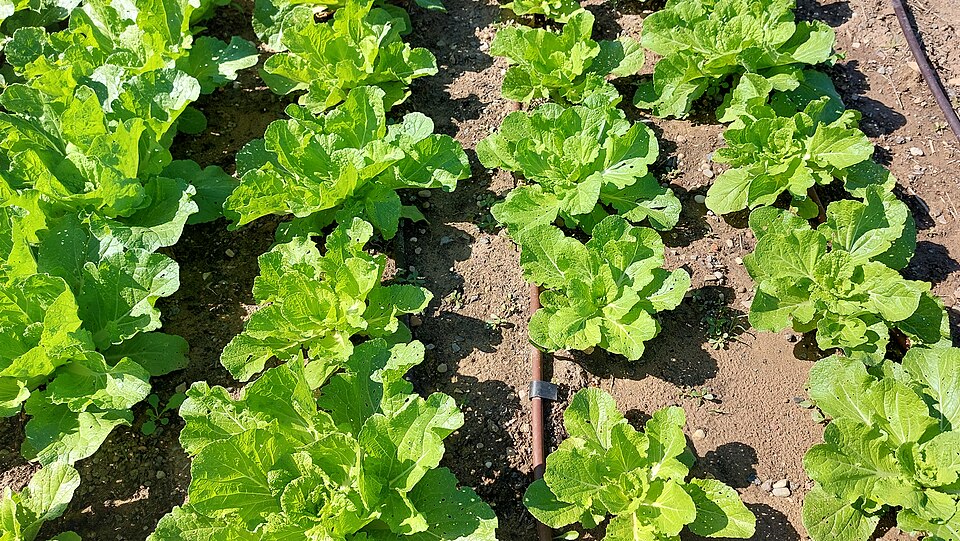
A covered tank 1–1.5 m up, a valve, a 120-mesh filter, a 25 mm main and 8 mm dripper lines: drip irrigation for a family plot by gravity, with no pump and no power.
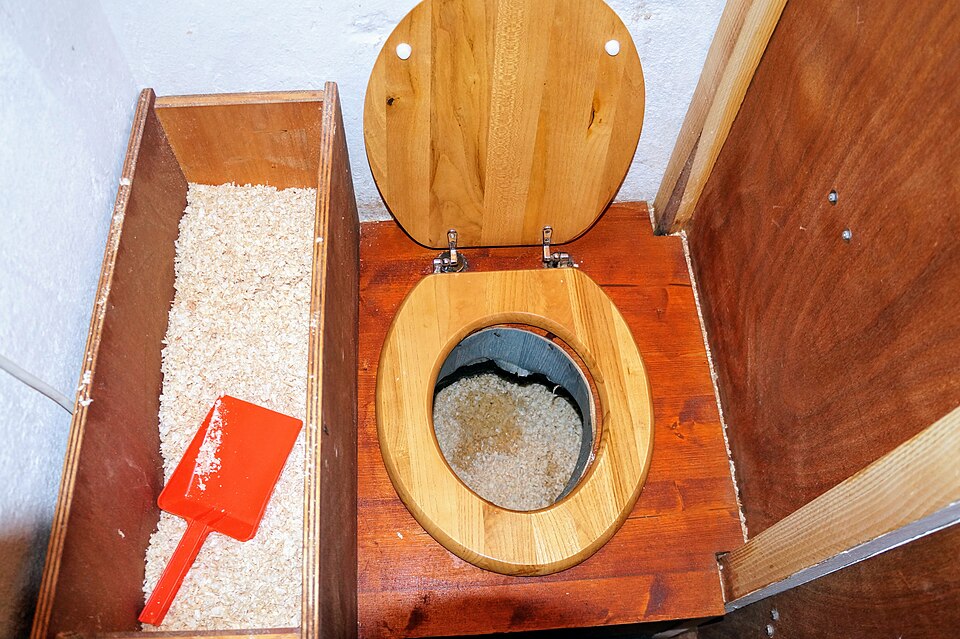
Break the faecal–oral route and return the nutrients — the highest lives-saved-per-effort structure a settlement can build.
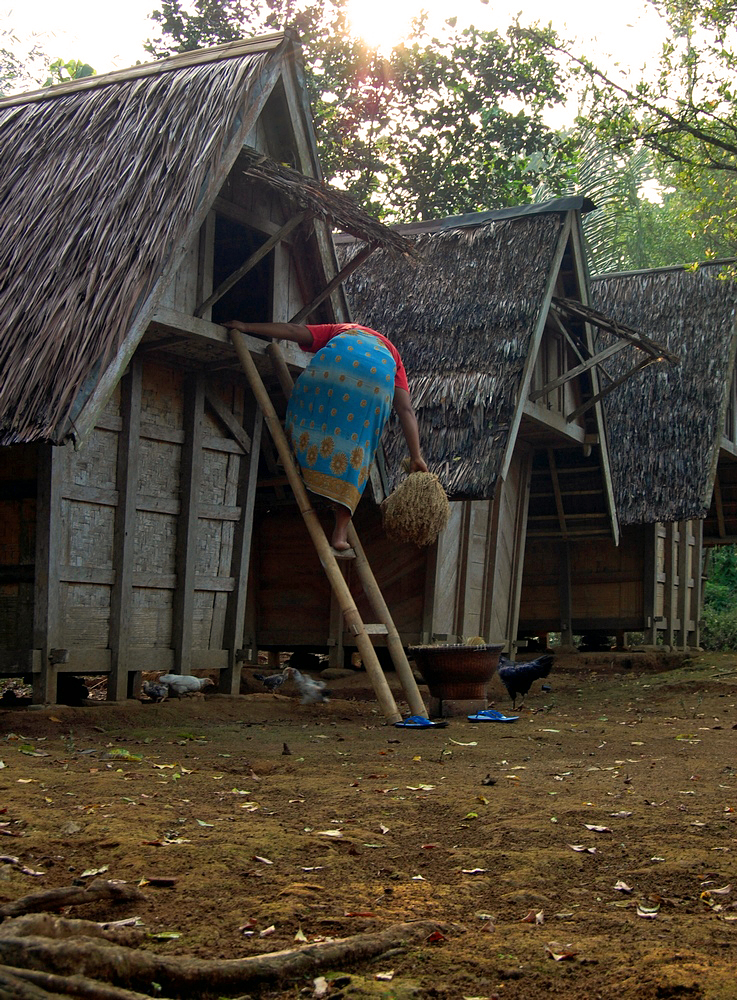
Keep a year of grain dry, cool and away from rodents — the single highest-return building on the site.
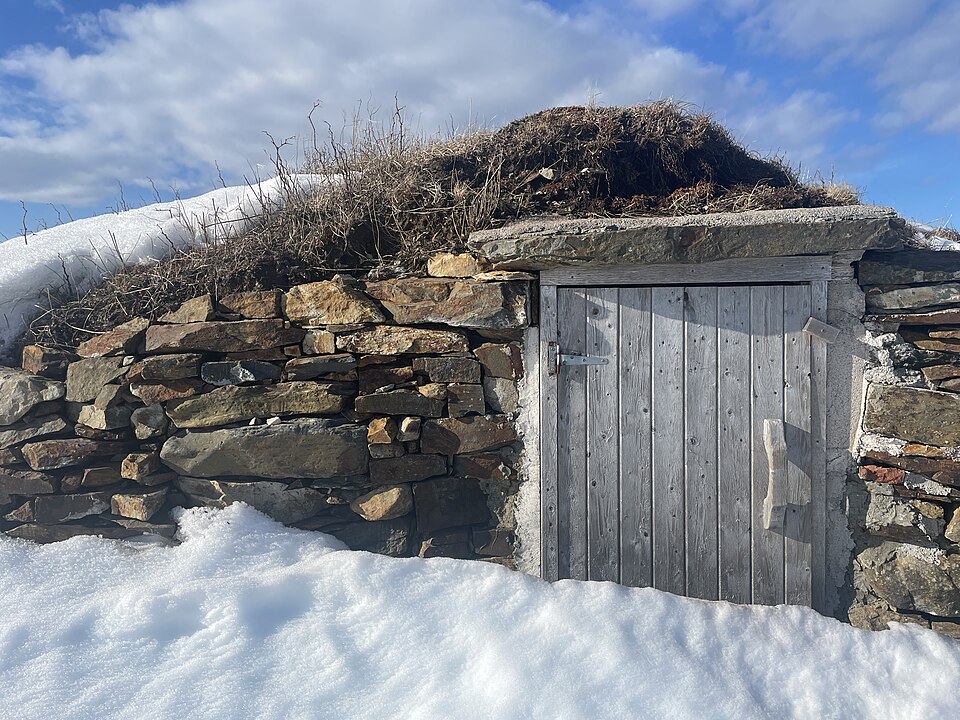
Cold, damp and dark, without power — how a harvest survives to the following spring.
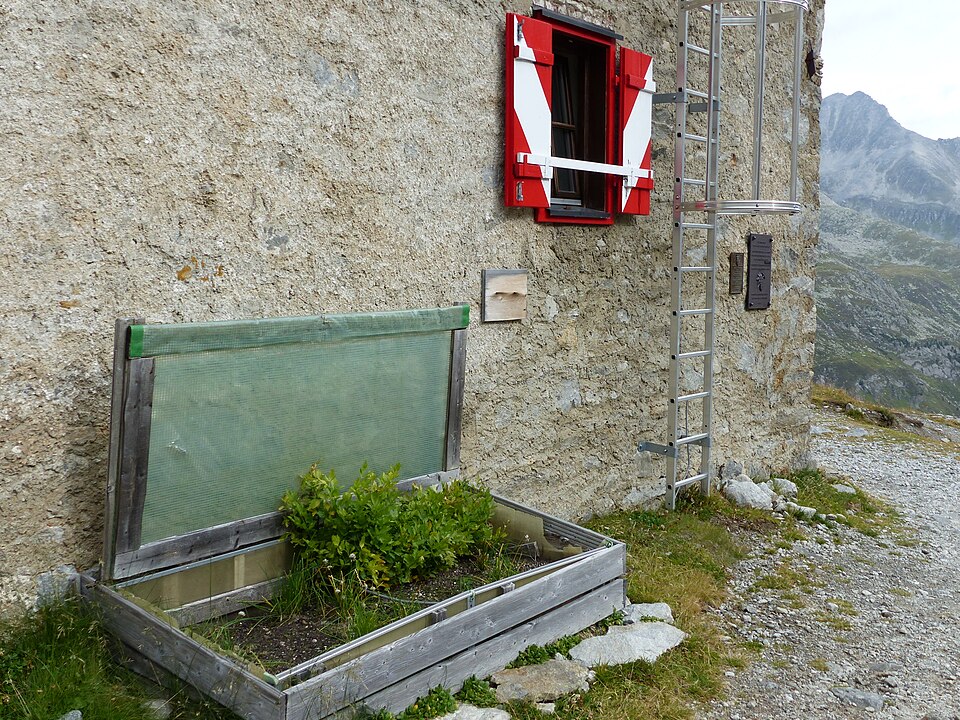
A glazed box that starts seedlings weeks early, and the same box over a pit of rotting manure that warms the soil from below.
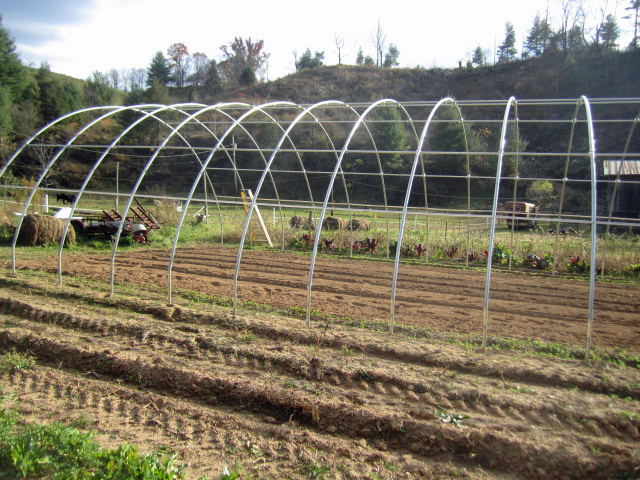
Steel bows on ground posts under one layer of greenhouse film, with sides that roll up: weeks added to both ends of the season, in the field's own soil.
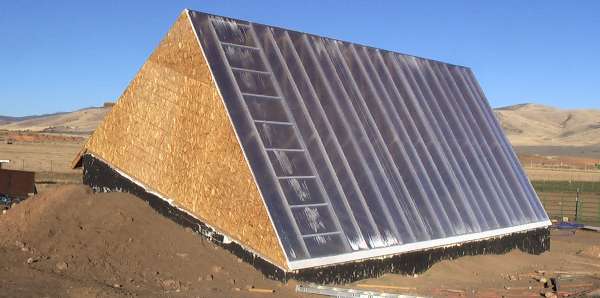
A greenhouse that heats itself: a heavy, insulated wall on the side away from the sun, film on the sunny side, and a blanket over the film at night.
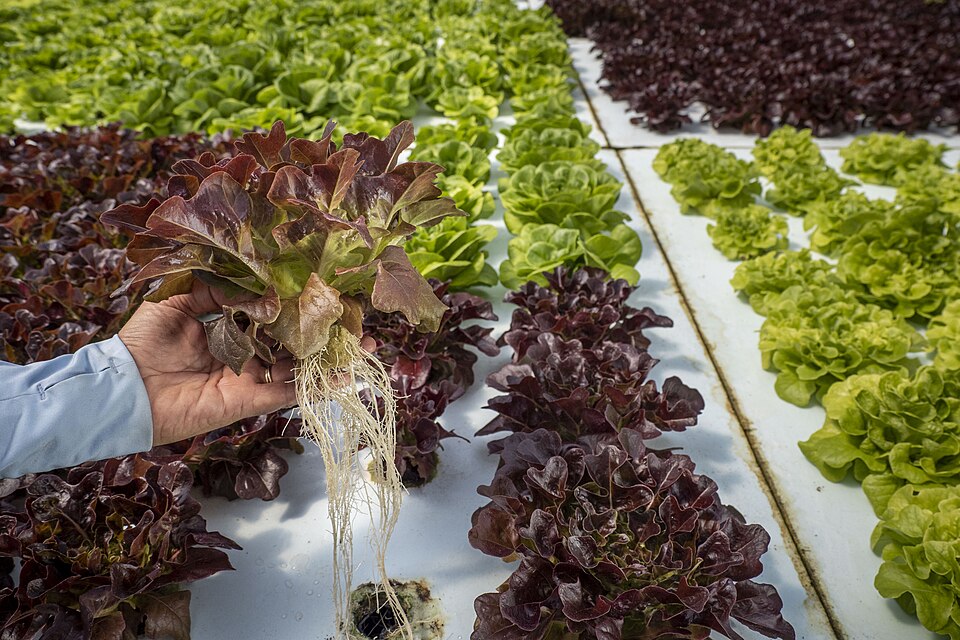
Eight covered channels 6 m long on a bench falling 2 %, a pump in a covered tank, and a film of solution 1–2 mm deep: lettuce without soil in 30–50 days.
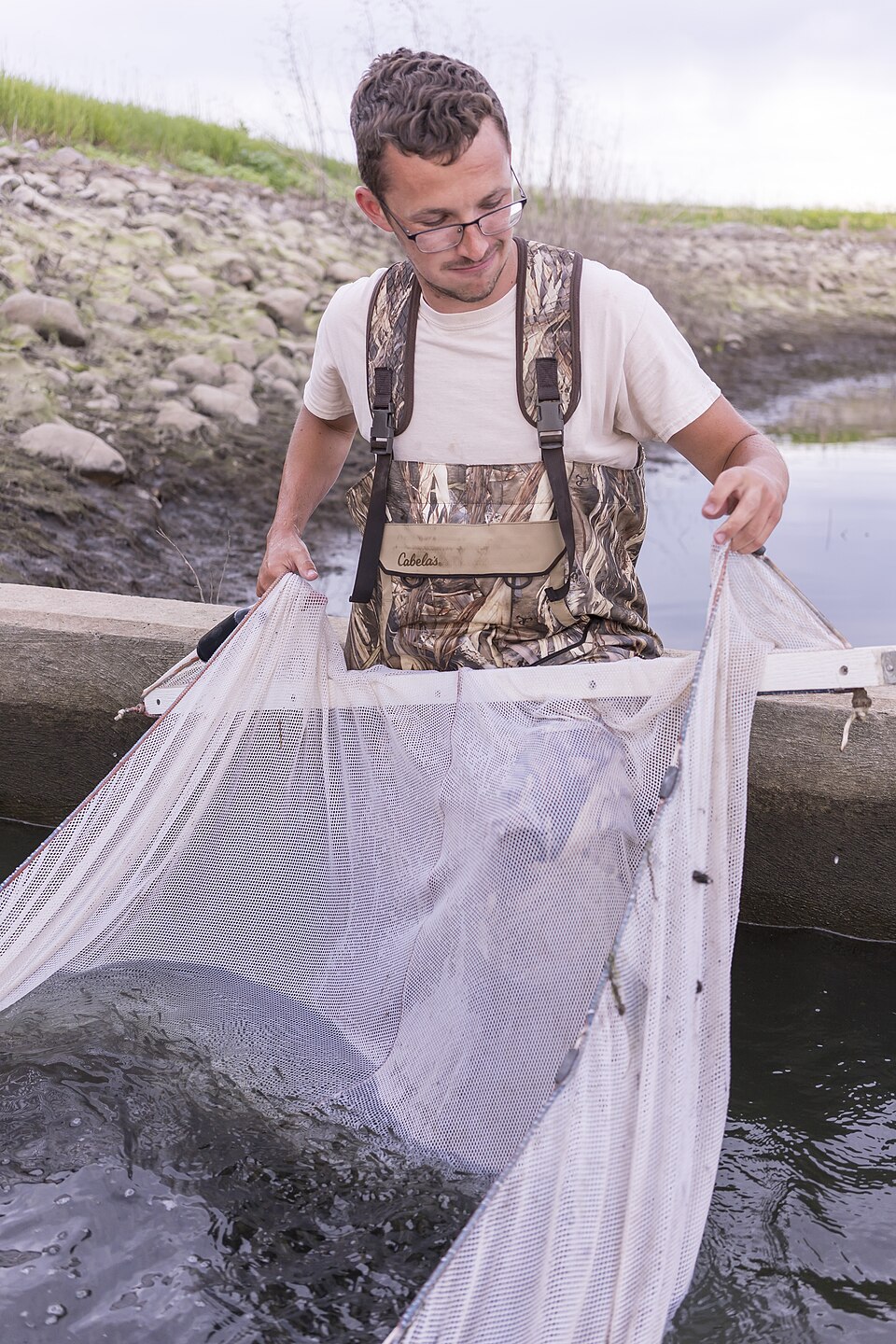
A 20 × 20 m earthen pond with rammed dikes, a screened inlet and a wooden monk: filled and drained by gravity, manured from the farm, and harvested every six months.
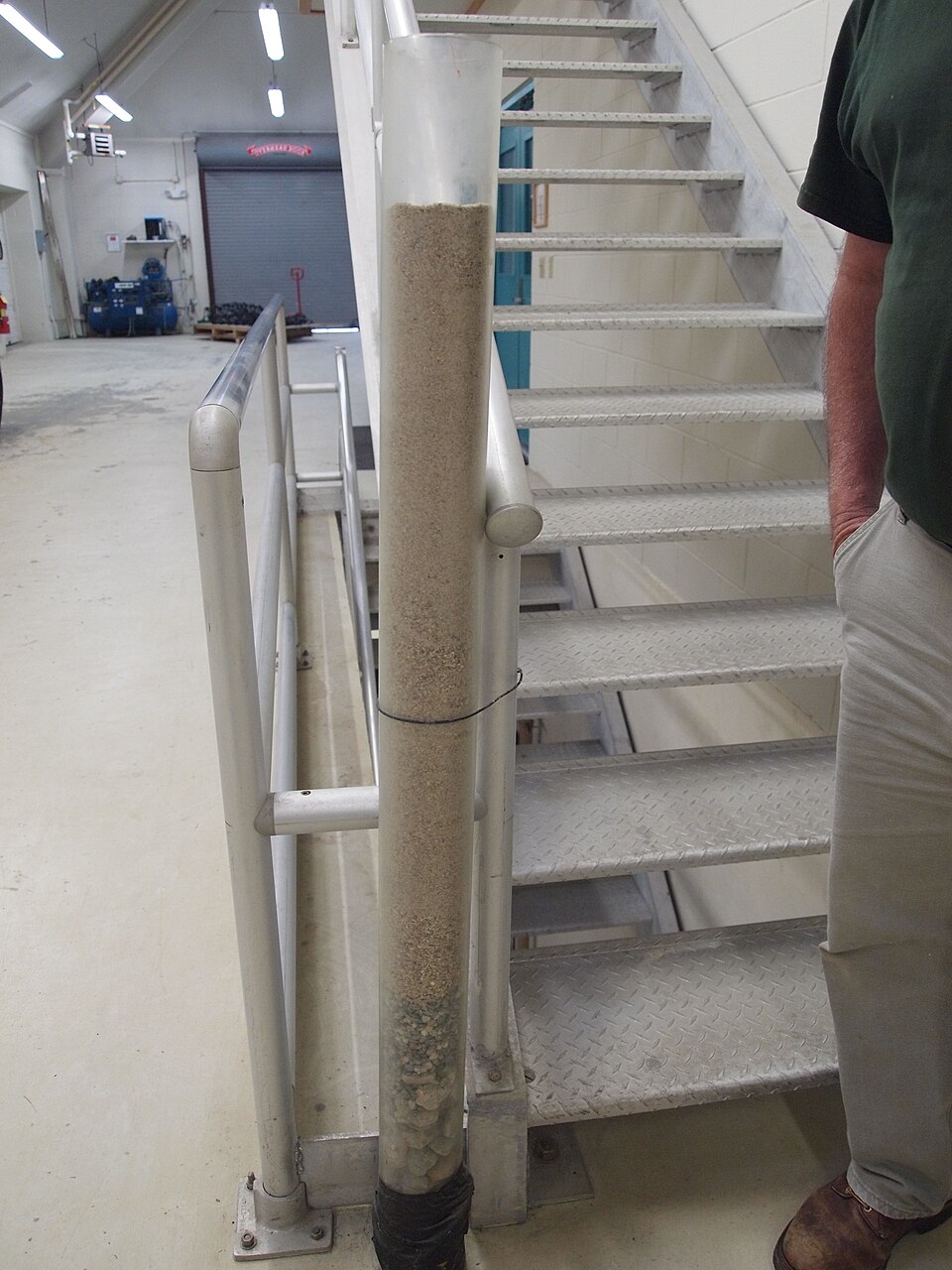
Clean drinking water with no chemicals, no power and no moving parts — the highest lives-saved-per-effort structure on this site.
Reference sheets
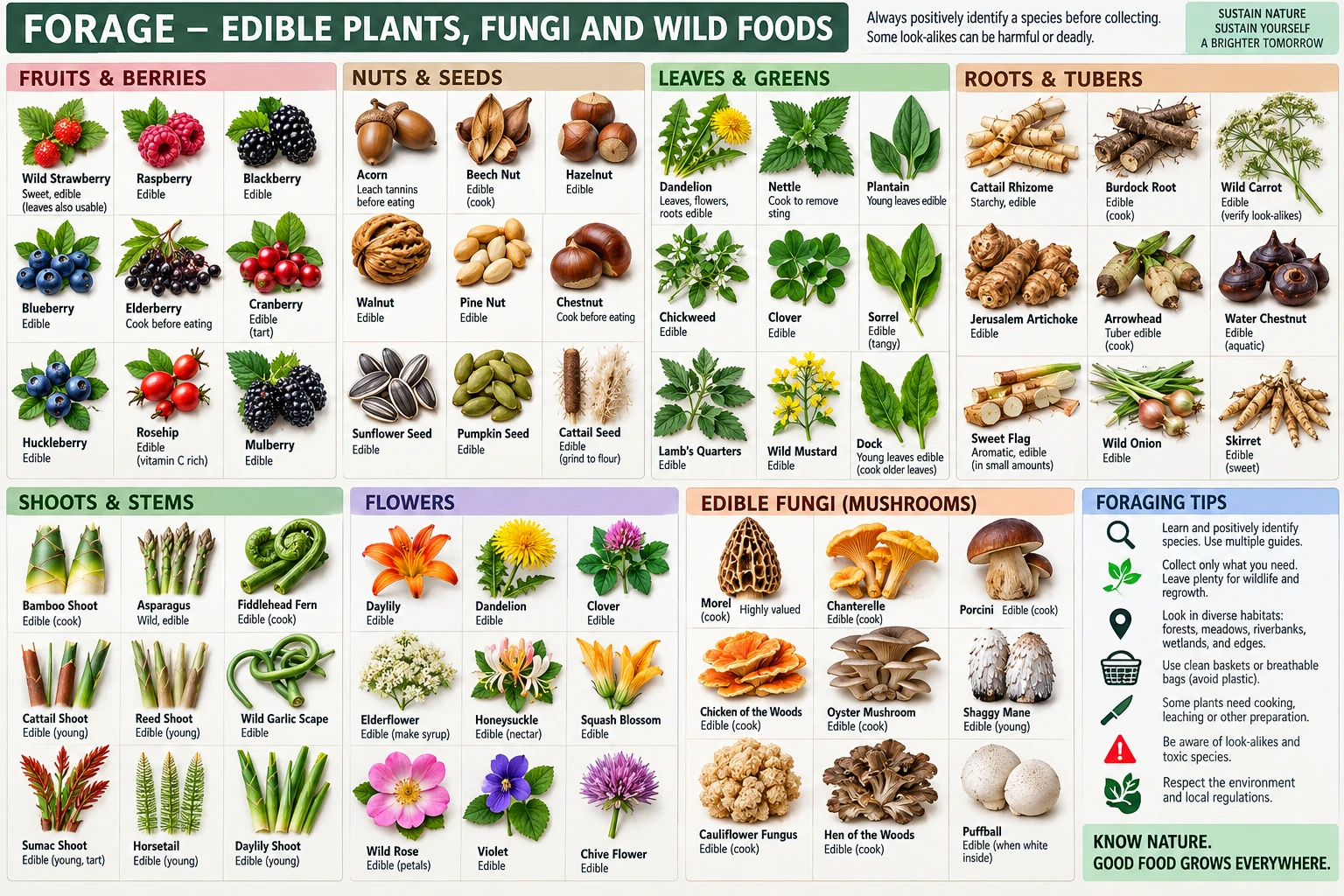
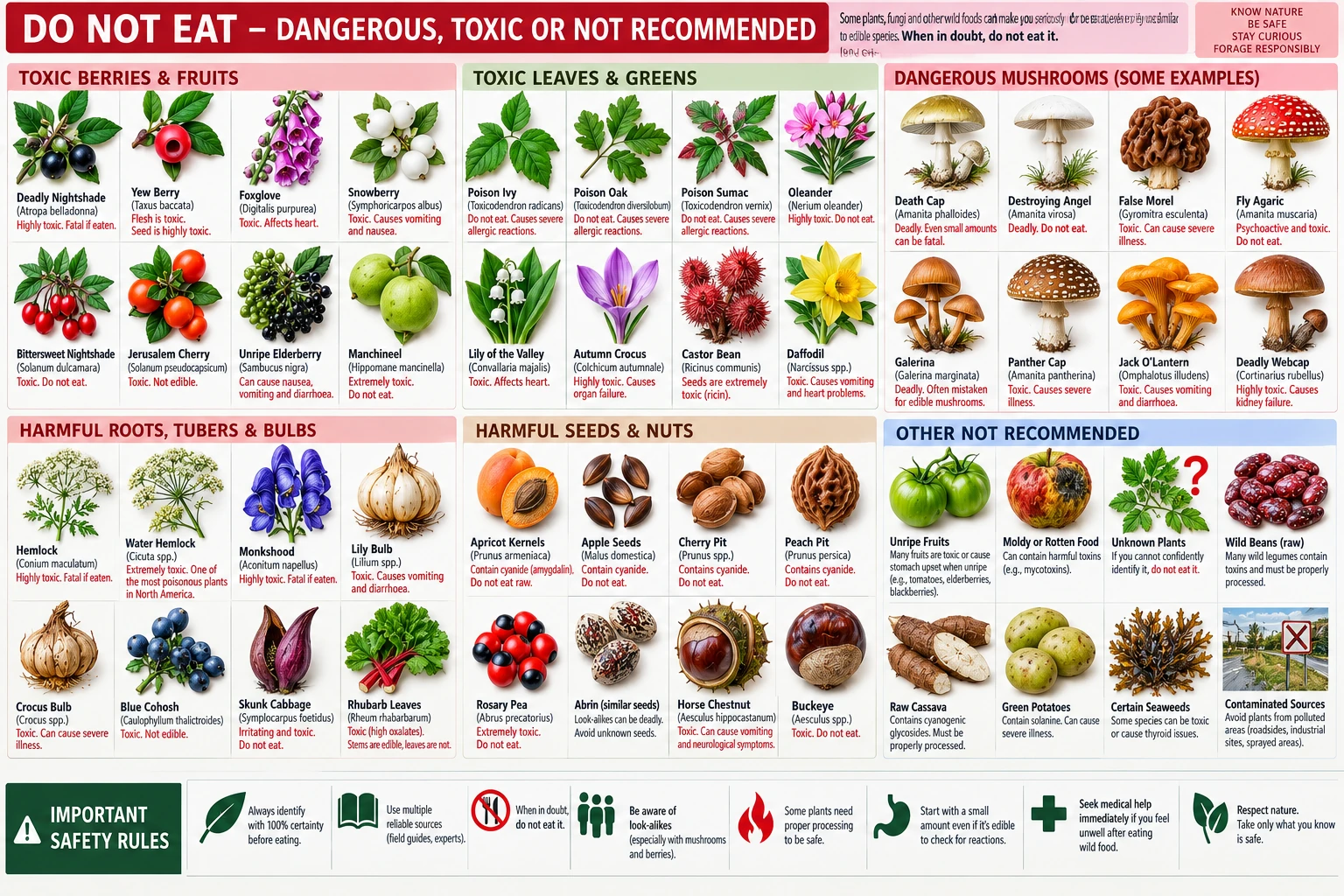
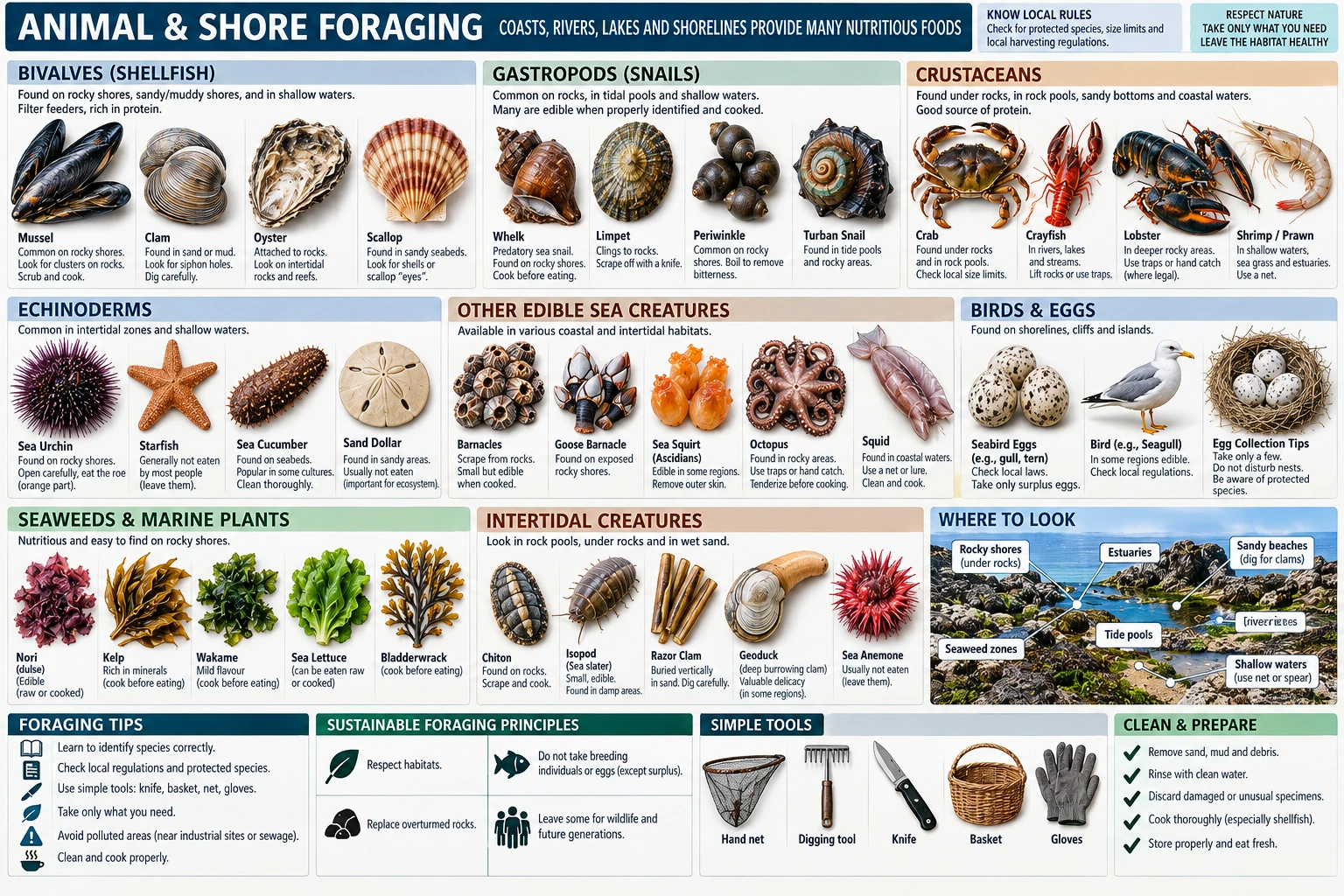
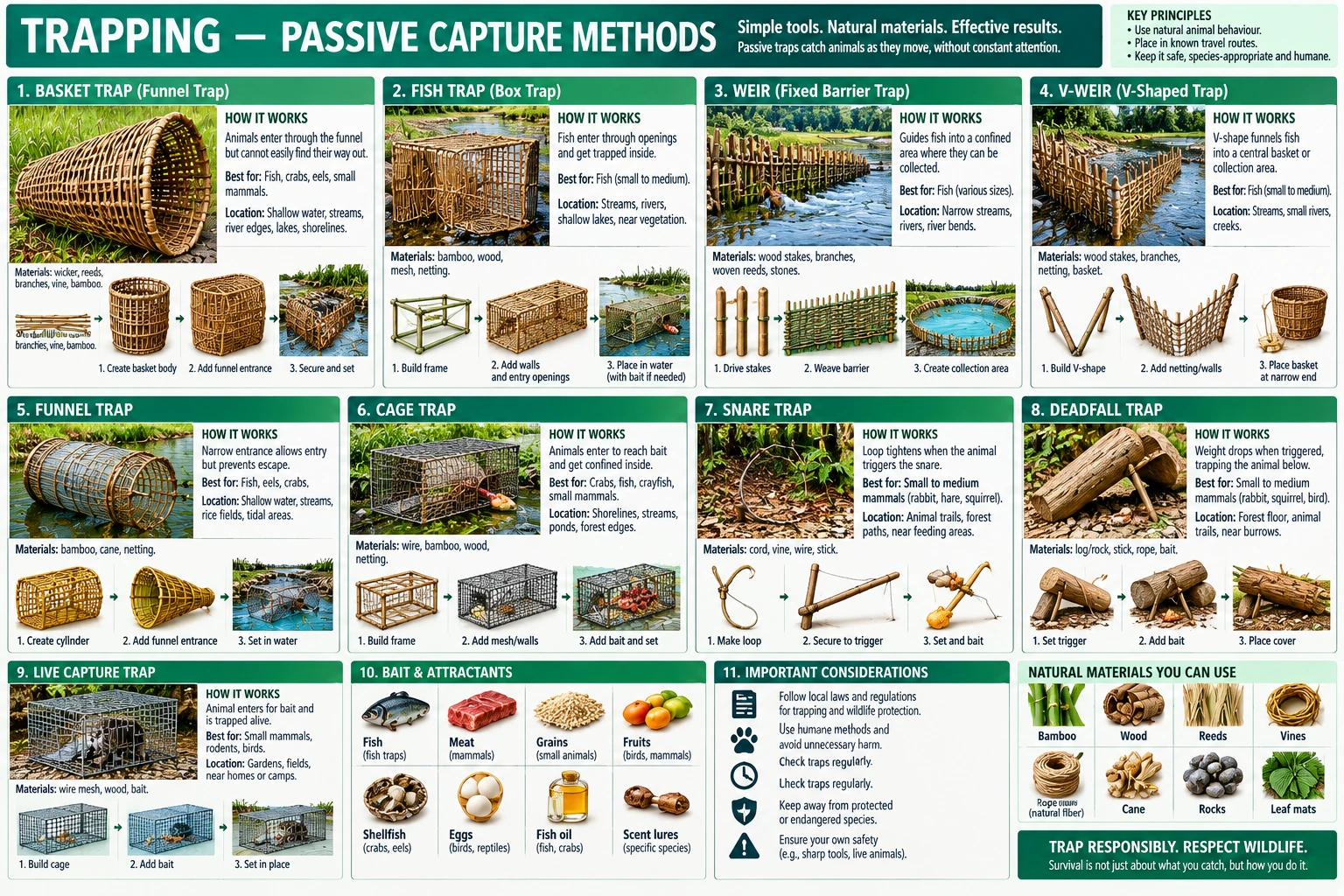
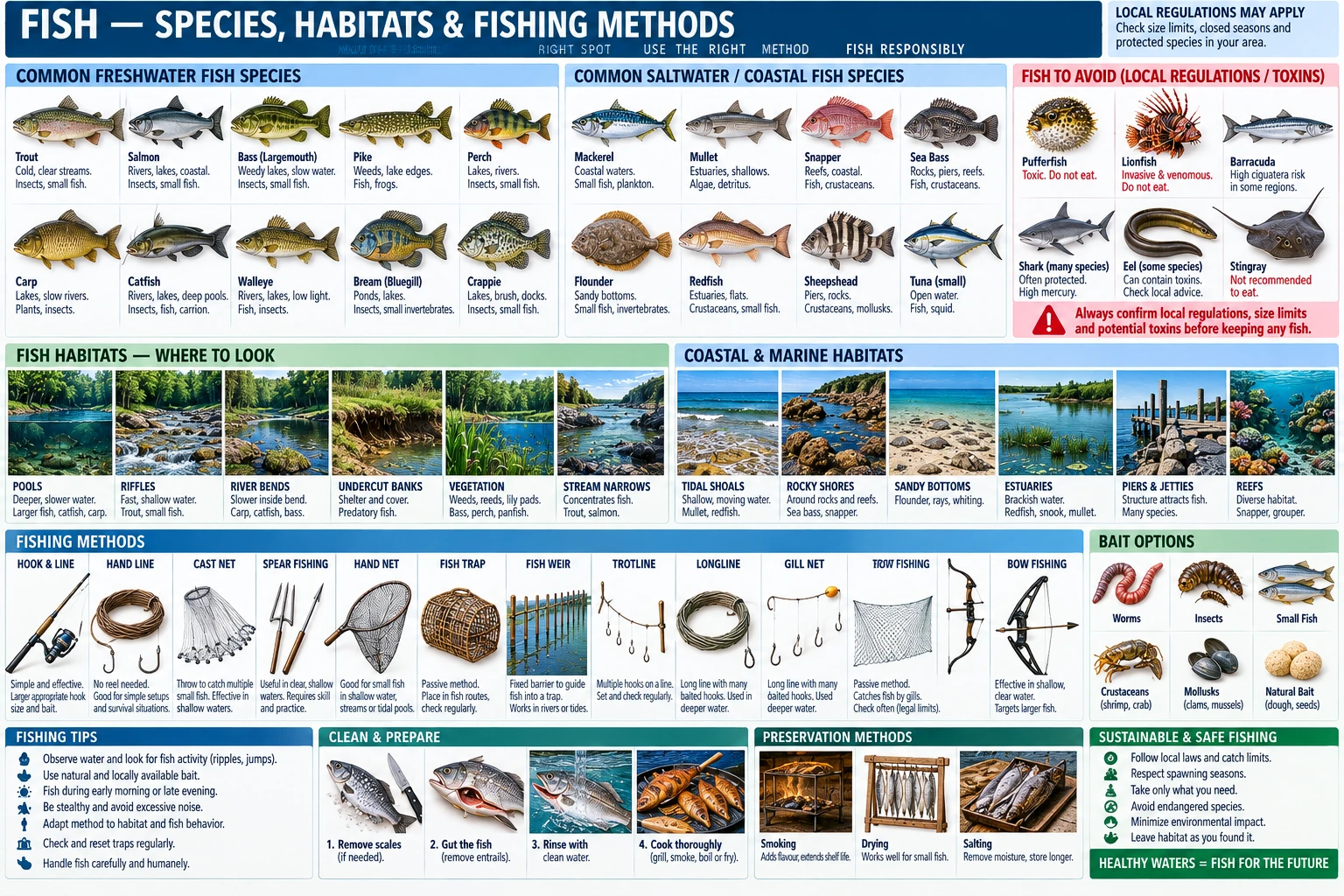
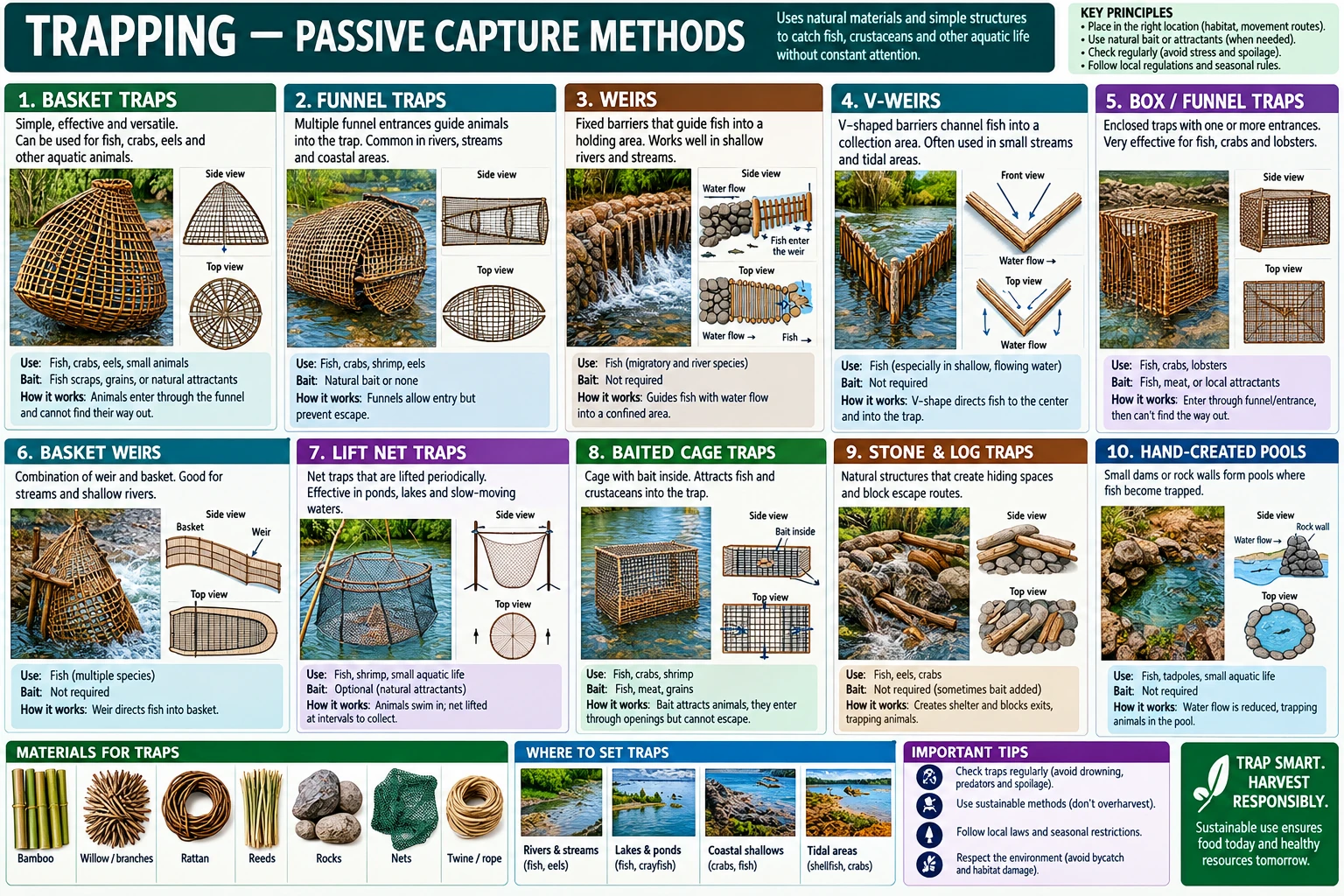
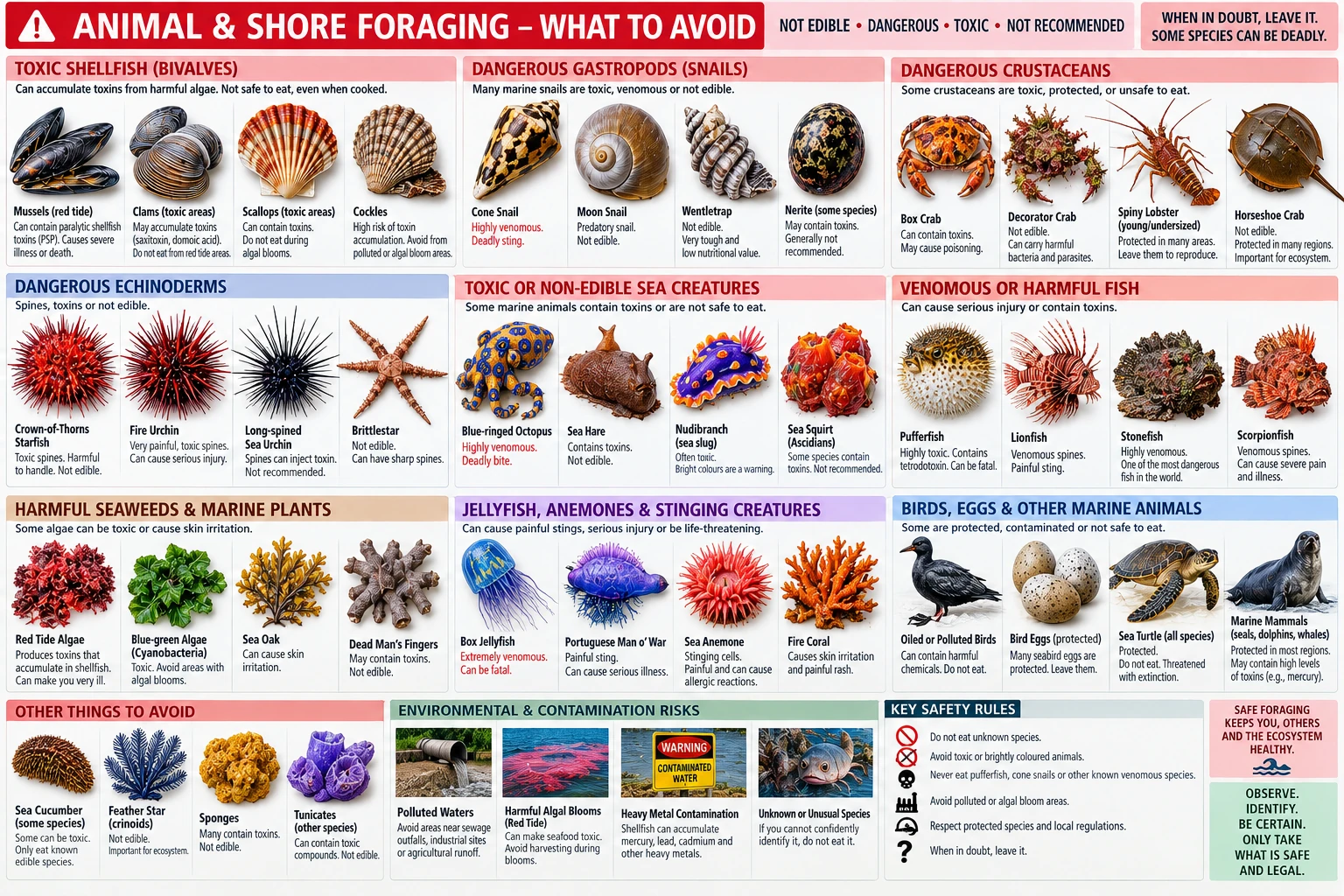
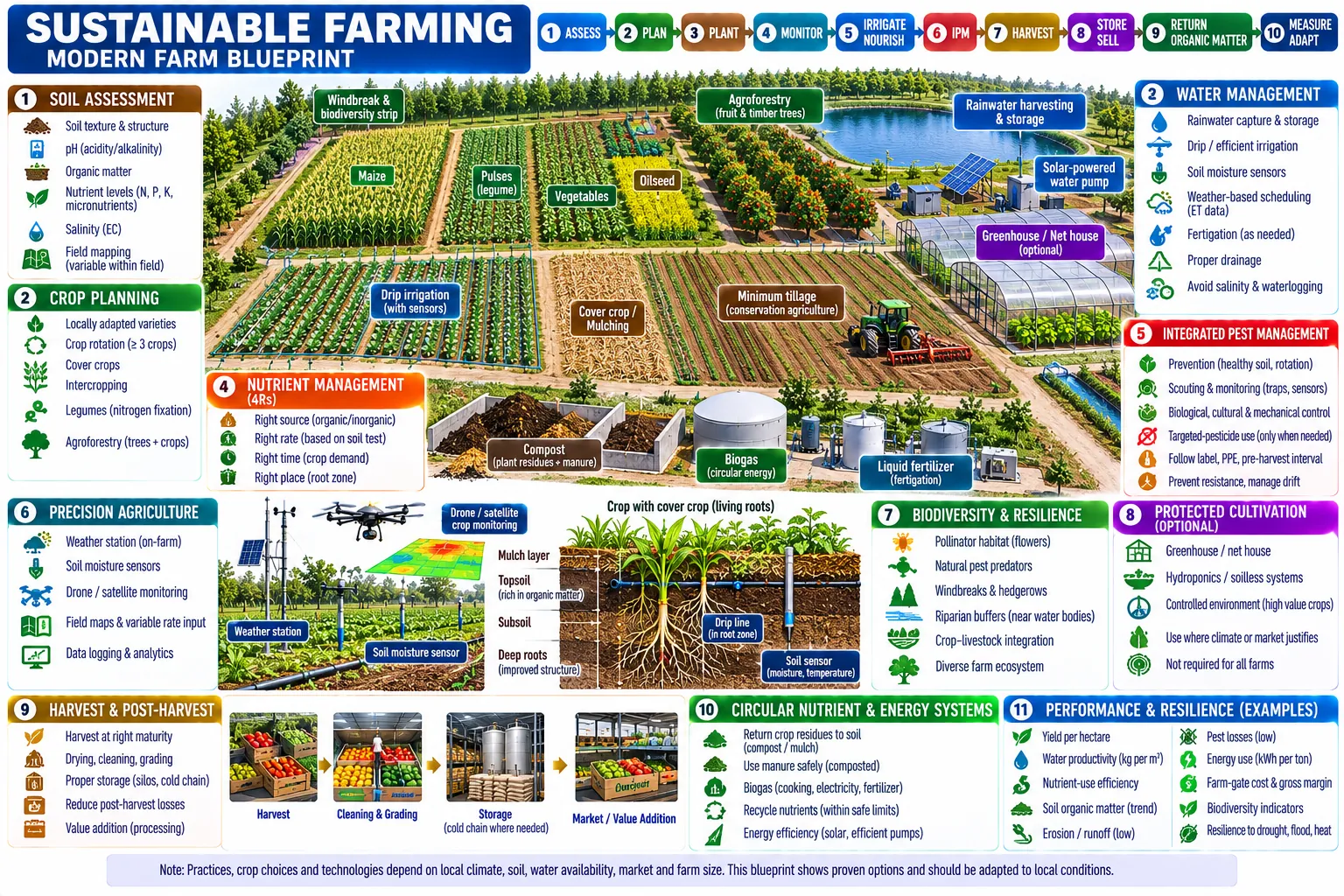
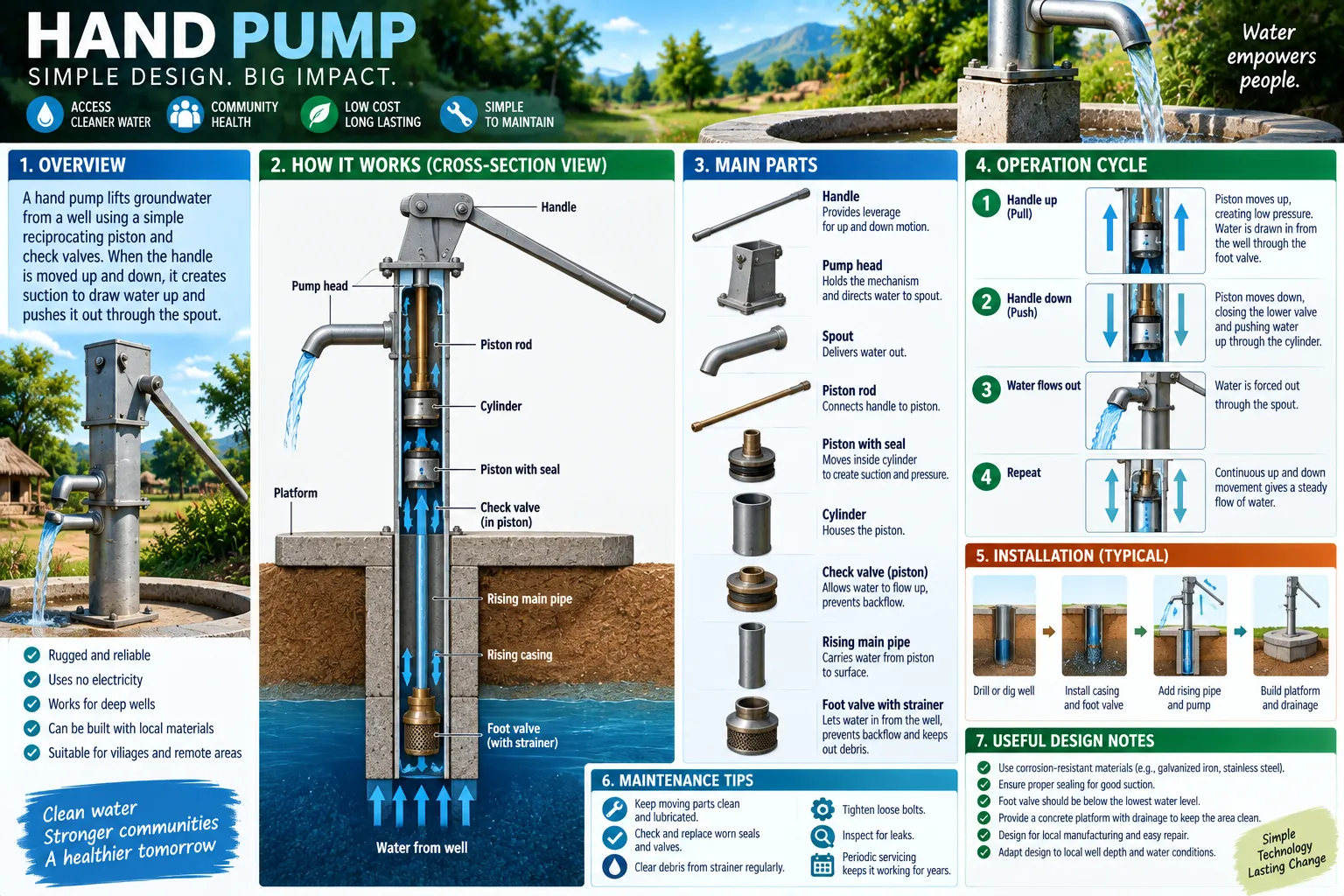
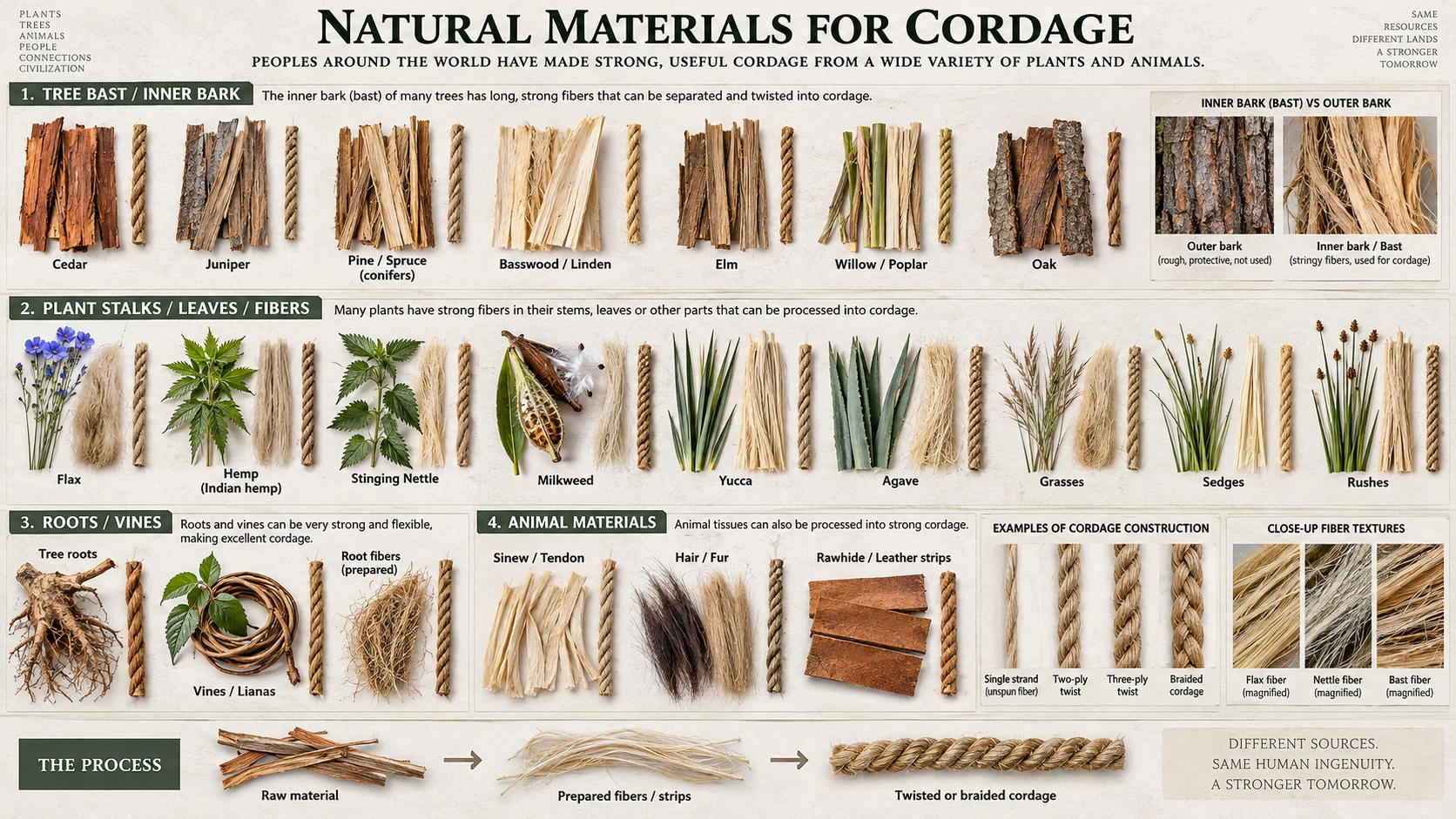
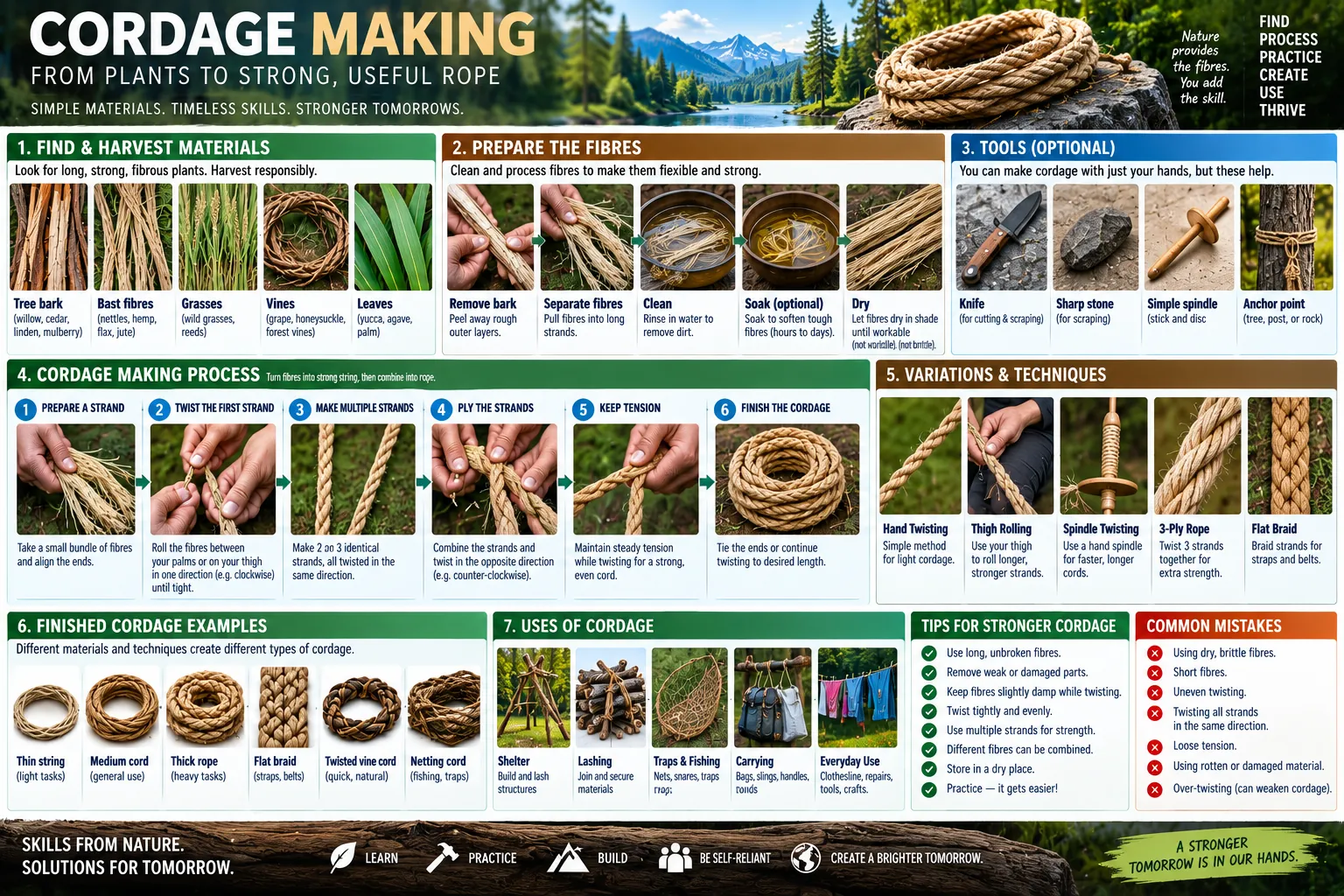
Drawn overview sheets, each with its corrections printed under it. They orient; they are never the thing you identify from.
Books and archives
- Bee Hunting John R. Lockard · Gutenberg #34044
- FAO agricultural documents Archive · ~10 GB
- Hesperian Health Guides Archive · ~50–400 MB
- Identification of the Larger Fungi Roy Watling · Gutenberg #60159
- Common poisonous plants of New England Heber W. Youngken, Jr. · Gutenberg #71397
- The Story of Rope Plymouth Cordage Company · Gutenberg #71807
- The Use of Ropes and Tackle Homer J. Dana and W. A. Pearl · Gutenberg #56585
- The Mechanical Properties of Wood Samuel J. Record · Gutenberg #12299
- CD3WD appropriate-technology archive Archive · ~13 GB
- WHO water, sanitation and health guidance Archive · ~200 MB
- Wikipedia, offline (Kiwix ZIM) Archive · ~110 GB full with images · ~55 GB no-image · ~5 GB 'best of'
- The Survivor Library Archive · ~100 GB
- A Treatise on Grain Stacking John N. De Lamater · Gutenberg #34586
- The Complete Book of Cheese Robert Carlton Brown · Gutenberg #14293
- Alcoholic Fermentation Arthur Harden · Gutenberg #44985
- Seat Weaving L. Day Perry · Gutenberg #53288
- Textiles William H. Dooley · Gutenberg #24077
- Hand-Loom Weaving Mattie Phipps Todd · Gutenberg #31630
- The Field and Garden Vegetables of America Fearing Burr · Gutenberg #21682
- The Culture of Vegetables and Flowers From Seeds and Roots Sutton & Sons Ltd. · Gutenberg #16232
- USDA / NRCS soil and conservation library Archive · ~5 GB
- The Story of the Soil Cyril G. Hopkins · Gutenberg #4527
- Home Vegetable Gardening F. F. Rockwell · Gutenberg #7123
- Talks on Manures Joseph Harris · Gutenberg #19448
- Manures and the Principles of Manuring Charles Morton Aikman · Gutenberg #27274
- Organic Gardener's Composting Steve Solomon · Gutenberg #4342
- Dry-Farming: A System of Agriculture for Countries under a Low Rainfall John A. Widtsoe · Gutenberg #4924
- A New Orchard and Garden William Lawson · Gutenberg #29058
- Pumps and Hydraulics (Part 1) N. Hawkins · Gutenberg #56339
- Surveying and Levelling Instruments William Ford Stanley · Gutenberg #63834
- Project Gutenberg (complete) Archive · ~90 GB with all formats · ~15 GB text only
- Creative Chemistry Edwin E. Slosson · Gutenberg #17149
- Principles and Practice of Agricultural Analysis: Fertilizers Harvey W. Wiley · Gutenberg #72438
- LibreTexts Archive · ~15 GB
- Acids, Alkalis and Salts George H. J. Adlam · Gutenberg #50552
- Nitro-Explosives: A Practical Treatise P. Gerald Sanford · Gutenberg #15308
- Dictionary of Explosives Arthur Marshall · Gutenberg #50446
- The Humanure Handbook Archive · ~20 MB
- A Treatise on Sheep Ambrose Blacklock · Gutenberg #38189
- Poultry: A Practical Guide Hugh Piper · Gutenberg #38606
- Special Report on Diseases of the Horse United States Bureau of Animal Industry · Gutenberg #23403
- Special Report on Diseases of Cattle United States Bureau of Animal Industry · Gutenberg #30310
- OpenStax textbooks Archive · ~2 GB
- Elements of Arithmetic Augustus De Morgan · Gutenberg #68662
- The Telescope Louis Bell · Gutenberg #53740
- On the Origin of Species By Means of Natural Selection Charles Darwin · Gutenberg #1228
- An anatomical disquisition on the motion of the heart & blood in animals William Harvey · Gutenberg #67065
- Micrographia Robert Hooke · Gutenberg #15491
- An Inquiry into the Causes and Effects of the Variolae Vaccinae Edward Jenner · Gutenberg #29414
- Encyclopædia Britannica, 11th edition (1911) Archive · ~1–8 GB depending on format
- Newton's Principia: The mathematical principles of natural philosophy Isaac Newton · Gutenberg #76404
- On the Construction of a Silvered Glass Telescope Henry Draper · Gutenberg #53542
- The Fundamentals of Bacteriology Charles B. Morrey · Gutenberg #43227
- The Elements of Bacteriological Technique J. W. H. Eyre · Gutenberg #27713
- Principles of Public Health Thomas Dyer Tuttle · Gutenberg #53974
- WHO, Immunization in Practice Archive · Free PDF download
- Water Supply: the Present Practice of Sinking and Boring Wells Ernest Spon · Gutenberg #45703
- Appropedia Archive · ~4 GB
- Wood Handbook (USDA Forest Products Laboratory) Archive · one PDF book
- Mechanics: The Science of Machinery A. Russell Bond · Gutenberg #49445
- Elements of Chemistry, In a New Systematic Order, Containing all the Modern Discoveries Antoine Laurent Lavoisier · Gutenberg #30775
- The Chemical History of a Candle Michael Faraday · Gutenberg #14474
- Practical Methods of Sewage Disposal for Residences, Hotels and Institutions Henry N. Ogden · Gutenberg #54244
- Sewerage and Sewage Treatment Harold E. Babbitt · Gutenberg #61773
- Practical Farm Buildings: Plans and Suggestions Andrew Frederick Hunter · Gutenberg #65618
- Carpentry Ira Samuel Griffith · Gutenberg #70226
- Woodwork Joints William Fairham · Gutenberg #21531
- Gardening Indoors and Under Glass F. F. Rockwell · Gutenberg #22484
- Woodward's Graperies and Horticultural Buildings George E. Woodward and F. W. Woodward · Gutenberg #25373
- Mysteries of Bee-keeping Explained M. Quinby · Gutenberg #25185
- Vegetable Dyes Ethel Mairet · Gutenberg #24076
- The Dyer's Guide Thomas Packer · Gutenberg #53797
- De Re Metallica Georgius Agricola (tr. Herbert Hoover) · Gutenberg #38015
- The Complete Distiller Ambrose Cooper · Gutenberg #65020
- The Practical Distiller Samuel McHarry · Gutenberg #21252
- On Laboratory Arts Richard Threlfall · Gutenberg #22784
- Merck's 1899 Manual of the Materia Medica Merck & Co. · Gutenberg #41697
- Treatise on Light Christiaan Huygens · Gutenberg #14725
- Experimental Researches in Electricity, Volume 1 Michael Faraday · Gutenberg #14986
- Reflections on the motive power of heat Sadi Carnot · Gutenberg #78610
- The Filtration of Public Water-Supplies Allen Hazen · Gutenberg #69025
- Chlorination of Water Joseph Race · Gutenberg #37389